
From digital 3D design to real metal components
Innovative Pfizer Healthcare Hub project automates material feed at the PCMM system
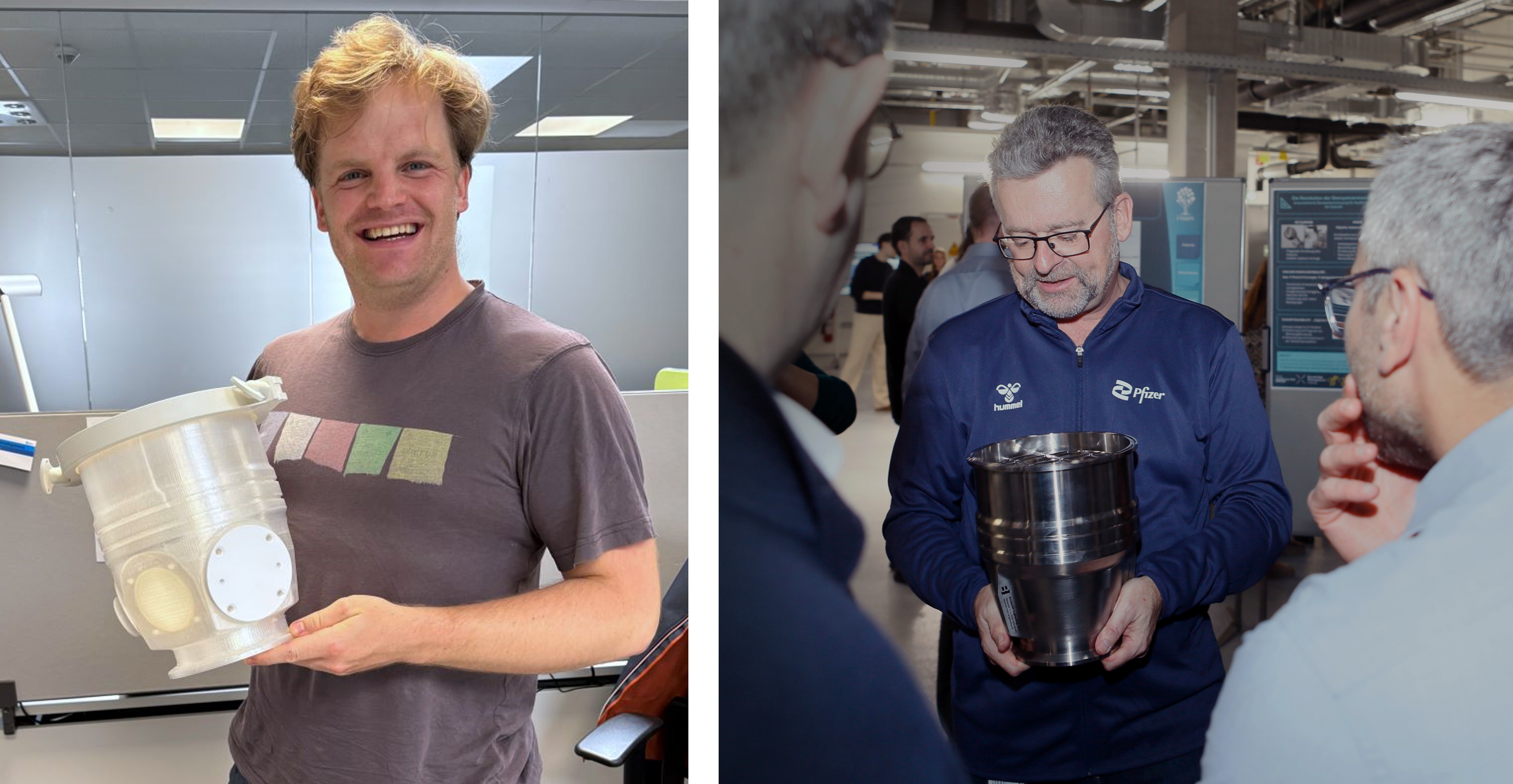
A newly developed adapter allows the process‑integrated delivery of auxiliary materials to the PCMM platform and the integration of process analytics. This pilot project illustrates how the Pfizer Healthcare Hub supports specialist teams in successfully implementing pilot projects.
Efficiency gains and remaining challenges at the PCMM platform
The Pfizer Continuous Manufacturing Module (PCMM) platform at Pfizer Freiburg represents a significant advancement in pharmaceutical manufacturing. This innovative technology enables continuous drug production, increasing efficiency and reducing downtime compared with traditional batch processes.
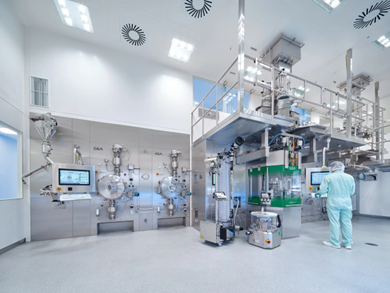
However, certain steps in the material supply process at the PCMM platform are still performed manually. Trained operators fill the system’s dosing unit with the required auxiliary materials at predefined intervals – a process that is organizationally complex, time‑consuming, and costly.
The Healthcare Hub supports process innovation projects at the Freiburg site
As a driver, enabler, and facilitator of process innovation, the Pfizer Healthcare Hub serves as the primary point of contact for Pfizer’s specialist departments and provides support for all optimization needs arising from day‑to‑day operations. This was also the case for the PPD adapter project. In search of support, the specialist department approached the Healthcare Hub with the goal of integrating process‑integrated material supply as well as options for sampling and process analytics into the production process.
In an initial step, the department’s requirements regarding design, handling, as well as EHS and quality aspects were defined. Based on this input, Pembe Gül Bilir, innovation engineer at the Pfizer Healthcare Hub Freiburg and lead of the pilot project, developed the project management plan, calculated the budget, and secured project funding through internal sponsors. For implementation, the Healthcare Hub also engaged external experts in design and manufacturing.
“From defining the requirements to managing the project, including budget planning, and tapping into a strong network of external solution providers, the Healthcare Hub supported the project at every stage. Ultimately, it’s a great example of how an idea can be transformed into a fully functional production component both quickly and cost‑effectively.”
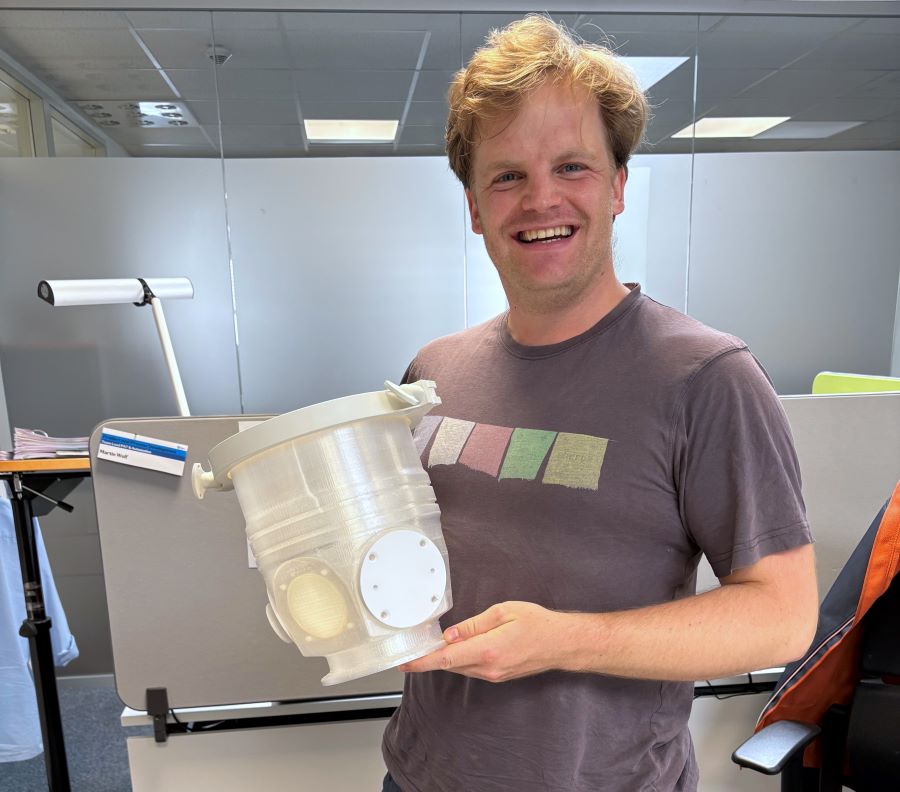
Lean development: the first prototype was manufactured using 3D printing
Following the completion of the design phase, which was carried out in collaboration with long‑standing partner Baumann Engineering, an initial adapter was produced using 3D printing.
Functional and handling tests were then conducted on the PCMM system using this prototype. The insights gained from these tests were used to finalize the adapter design. Only after this validation step was the final metal adapter manufactured.
This iterative approach ensured that a practical, fit‑for‑purpose solution was in place before moving on to the more cost‑intensive metal production, with the investment based on robust test results.
What sets the adapter apart?
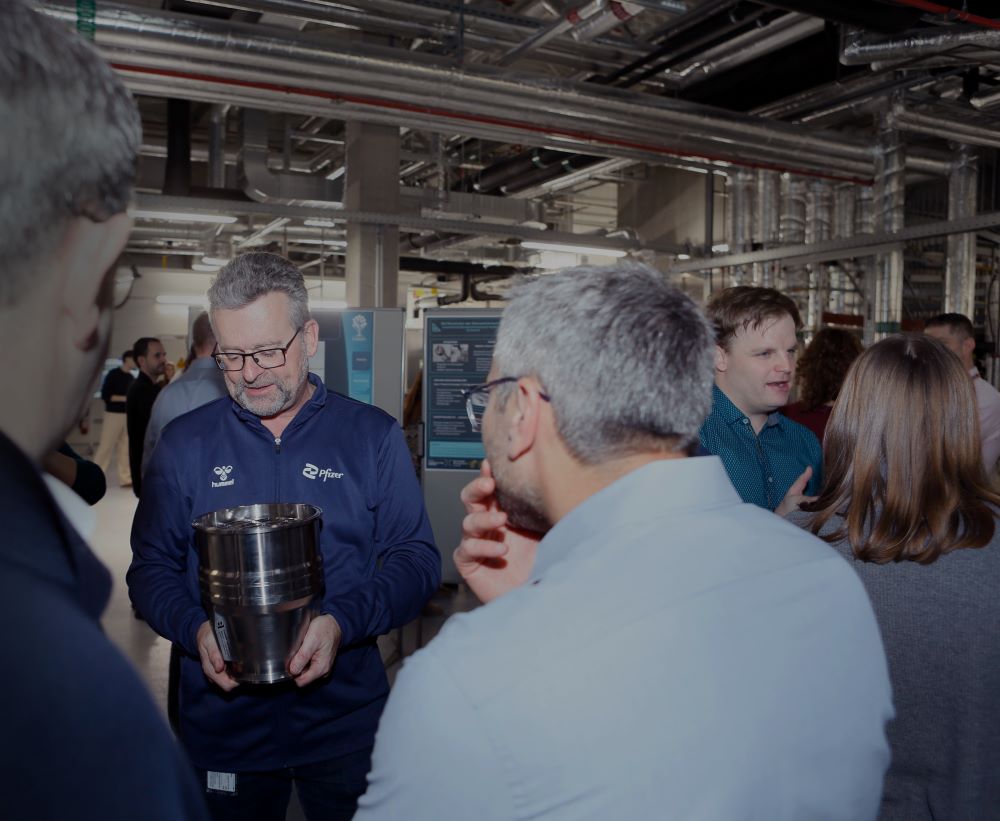
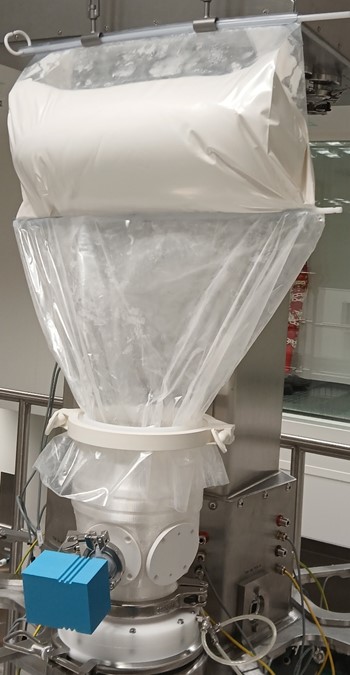
Based on the defined requirements, engineers at Baumann developed an adapter that enables a safe and dust‑free transfer of materials directly from supply bags into the dosing station – without any additional transfer steps.
This reduces manual handling, improves occupational safety, and lowers material costs.
In addition, the solution is modular and scalable, making it suitable for potential implementation at other sites in the future.