
How do tech companies successfully collaborate with Pfizer?
An interview on innovation, requirements, and what makes collaboration with Pfizer successful
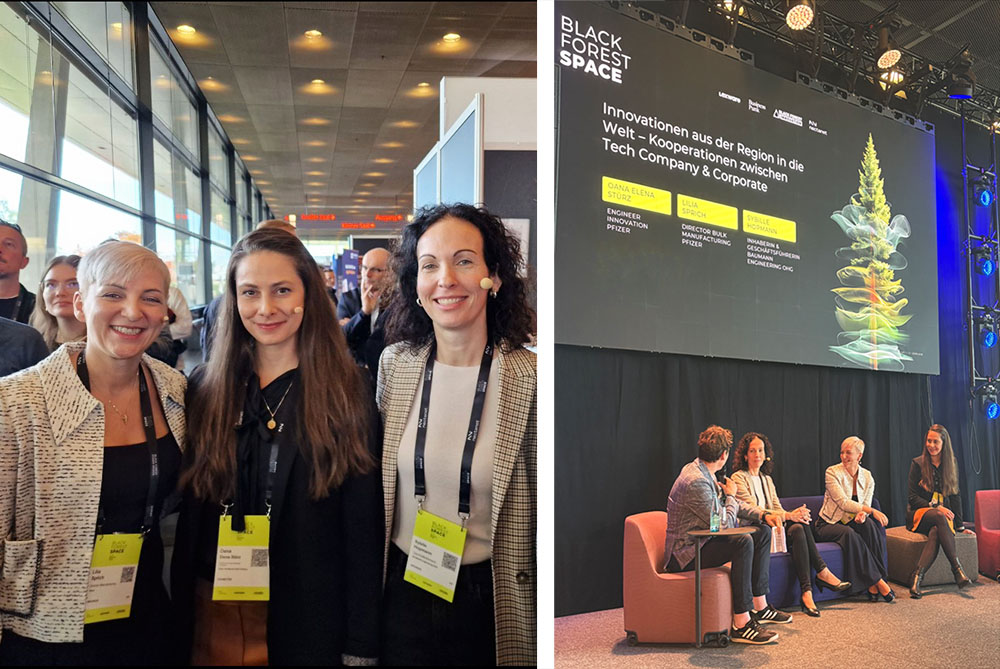
Innovation today increasingly emerges at the intersection of agile tech companies and established corporates, whose complementary strengths drive meaningful progress. At the Pfizer Healthcare Hub, collaborations aimed at process optimization at Pfizer’s Freiburg manufacturing site are strategically coordinated – enabling new solutions to be piloted in a structured way and scaled successfully thereafter. How such partnerships work in practice, and which factors are critical to their success, is illustrated through insights from Oana Stürz (Pfizer), Lilia Sprich (Pfizer), and Dr.-Ing. Sybille Hopmann (Baumann OHG).
What role does innovation management play for Pfizer and the Freiburg manufacturing site?
Lilia Sprich: "Innovation management is an integral part of our manufacturing strategy. As one of the world’s most advanced sites for solid dosage forms, we carry responsibility for supply security, efficiency, and quality across multiple markets.
Innovation management – particularly through the Pfizer Healthcare Hub Freiburg – enables us to introduce new technologies into manufacturing in a controlled manner: first through pilot projects, then by scaling successful solutions. This approach allows us to combine operational excellence with long‑term future readiness.
At the same time, innovation also has a cultural impact. It fosters cross‑functional thinking, increases openness to new solution approaches, and strengthens collaboration between manufacturing, digitalization, and external partners. This represents a clear competitive advantage for our site."
What role does the Pfizer Healthcare Hub play in optimizing manufacturing processes at the Freiburg site?
Oana Stürz: "The Freiburg site is one of Pfizer’s most advanced pharmaceutical manufacturing facilities, with very high expectations when it comes to quality, efficiency, and sustainability. To consistently meet these standards and ensure a reliable supply for patients, we need to continuously improve our production processes.
This is where the Healthcare Hub comes in. We act as the innovation engine for the site and work at the intersection of operations, external innovators, and Pfizer’s global network. Together with trusted mid-sized tech partners, we co-create solutions that address real manufacturing challenges. These solutions are first developed and tested locally, but always with the goal of being scalable across the global Pfizer network.
What makes this approach so effective is the agility and speed our external partners bring. It allows us to move quickly, test new ideas pragmatically, and stay closely connected to the broader innovation ecosystem."
What does Pfizer expect from solutions developed by external companies?
Lilia Sprich: "Pharmaceutical manufacturing operates within a highly regulated environment. GMP compliance, data integrity, validation, and clearly defined responsibilities are not optional, they are foundational requirements. For this reason, it is essential that external partners develop an early and thorough understanding of our regulatory and operational framework.
Beyond technical feasibility, external solutions must address clearly defined industrial challenges. They need to be designed for industrial scale, robustness, and regulatory compliance. Equally important is their ability to integrate seamlessly into existing processes and systems. Innovation should support operational stability and performance, not compromise it.
At the Freiburg site, early co‑creation has proven particularly effective. By involving production, quality, engineering, and external partners from the outset, requirements can be aligned early and iterations managed efficiently before moving into implementation.
We also place strong emphasis on partnership on equal footing. This includes openness to feedback from day‑to‑day operations, a willingness to adapt, and a shared understanding that solutions must perform reliably within a GMP environment – not only at the prototype stage.
When these expectations are met, true win‑win scenarios emerge. External partners gain access to a global manufacturing network, while Pfizer benefits from solutions that can be scaled well beyond the Freiburg site."
How does Pfizer identify solutions for specific optimization needs from its functional departments, manufacturing, and packaging operations?
Oana Stürz: "As innovation managers at Pfizer, we serve as the first point of contact for both internal and external innovation inquiries. To effectively connect these two sides, we have established a dedicated format called “InnoSessions.”
Each InnoSession brings together external technology providers and Pfizer experts to address clearly defined manufacturing challenges. The goal is to enable a focused, direct exchange on potential solution approaches, technical feasibility, and strategic value. This structured format allows us to align concrete operational needs with external innovation capabilities at an early stage, creating a solid foundation for targeted collaboration and further development."
How do you experience working with a large corporation like Pfizer as a mid-sized technology company?
Dr.-Ing. Sybille Hopmann: "The collaboration works so well because both partners contribute their respective strengths. As a mid-sized company, we are able to act quickly and implement new ideas with a high degree of agility. Pfizer, on the other hand, brings global reach, strong structures, and market access, which are essential to scaling innovations sustainably.
What makes a real difference is the direct exchange with the teams. This close collaboration ensures that ideas are translated into tangible solutions efficiently and with a clear understanding of real-world requirements."
What key learnings from working with Pfizer would you share with other tech companies or start-ups looking to build similar partnerships?
Dr.-Ing. Sybille Hopmann: "One key learning is the importance of being willing to adapt to the structures and processes of a large corporation. Understanding and working within these frameworks is essential for a successful collaboration.
At the same time, it is highly effective to start with a clearly defined pilot project. This allows partners to demonstrate value quickly, build trust, and establish a solid foundation for further cooperation. Having an internal sponsor within the organization who actively supports and drives the project forward can make a significant difference.
Once you are able to demonstrate that your technology works reliably within a corporate environment, new opportunities naturally follow – often opening the door to further collaborations and long-term partnerships."
What recommendations would you give for making collaborations between external companies and a corporation like Pfizer successful?
Oana Stürz: "Start small, think big: A clearly defined pilot project helps build trust and lays the foundation for a long-term partnership. Equally important is aligning expectations early on. Objectives, responsibilities, and timelines need to be clearly defined from the outset to ensure efficient and effective collaboration."